My 1980 Articles about Draft Registration
In 1980, I was a college freshman. When President Carter announced the resumption of draft registration, I was at Framingham State College, where I wrote my first “survey” article on this topic (see the end of this post). That summer, I transferred to the University of Massachusetts at Amherst, where I wrote a more extensive article as a freelancer for the Amherst Record.
These articles were written before I took a single journalism class, and I am embarassed by the unattributed facts I included. I am also not proud that I did not include any of the interviews I did with young women in the Amherst Record article, although I did include female students in the earlier survey and article. – mjw
Automated Optical Character Recognition (OCR) by Google Gemini.
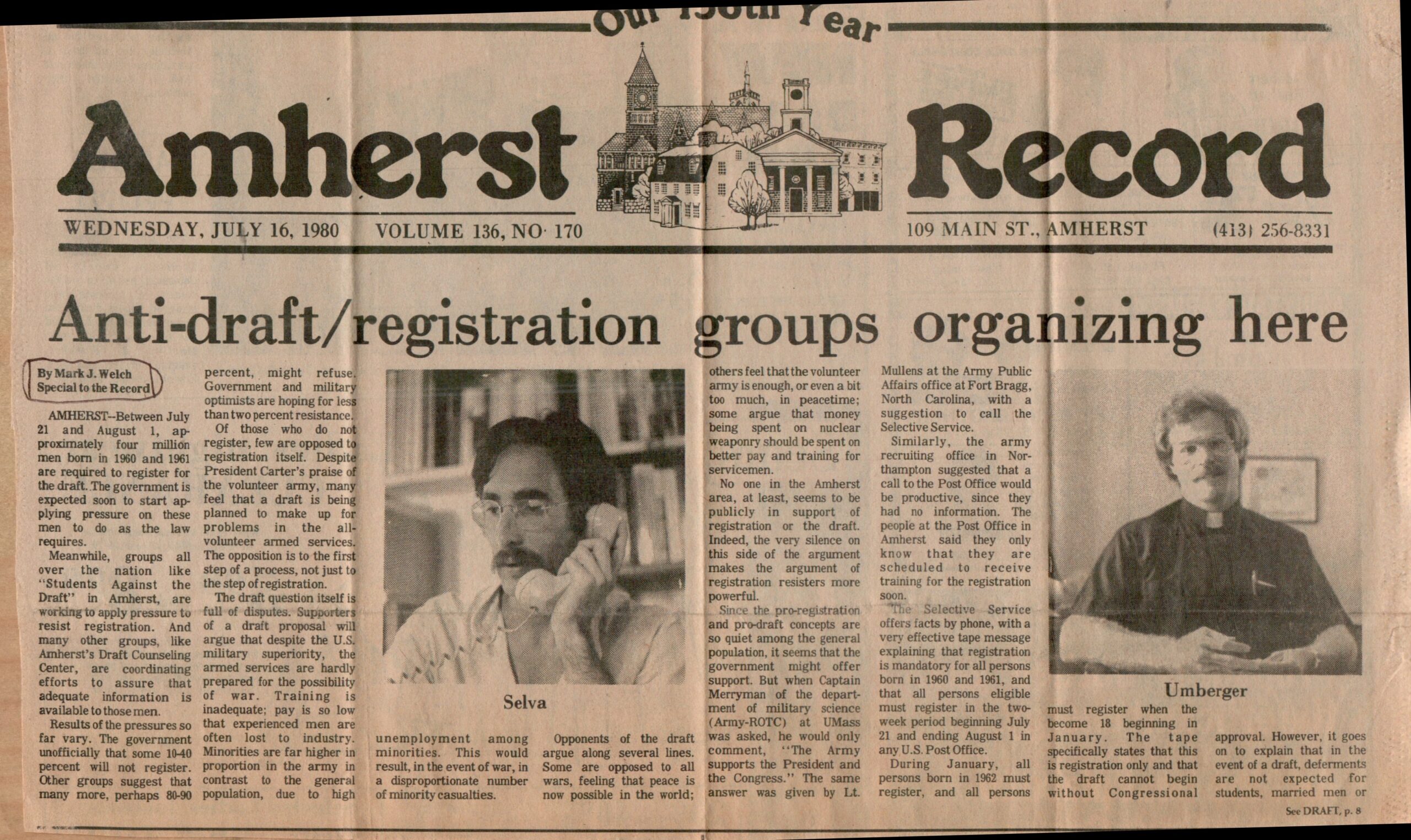
Amherst Record Volume 136, Number 170
Wednesday, July 16, 1980
“Anti-draft/registration groups organizing here“
By Mark J. Welch Special to the Record
AMHERST—Between July 21 and August 1, approximately four million men born in 1960 and 1961 are required to register for the draft. The government is expected soon to start applying pressure on these men to do as the law requires.
Meanwhile, groups all over the nation like “Students Against the Draft” in Amherst, are working to apply pressure to resist registration. And many other groups, like Amherst’s Draft Counseling Center, are coordinating efforts to assure that adequate information is available to those men.
Results of the pressures so far vary. The government unofficially that some 10-40 percent will not register. Other groups suggest that many more, perhaps 80-90 percent, might refuse. Government and military optimists are hoping for less than two percent resistance.
Of those who do not register, few are opposed to registration itself. Despite President Carter’s praise of the volunteer army, many feel that a draft is being planned to make up for problems in the all-volunteer armed services. The opposition is to the first step of a process, not just to the step of registration.
The draft question itself is full of disputes. Supporters of a draft proposal will argue that despite the U.S. military superiority, the armed services are hardly prepared for the possibility of war. Training is inadequate; pay is so low that experienced men are often lost to industry. Minorities are far higher in proportion in the army in contrast to the general population, due to high unemployment among minorities. This would result, in the event of war, in a disproportionate number of minority casualties.
Opponents of the draft argue along several lines. Some are opposed to all wars, feeling that peace is now possible in the world; others feel that the volunteer army is enough, or even a bit too much, in peacetime; some argue that money being spent on nuclear weaponry should be spent on better pay and training for servicemen.
No one in the Amherst area, at least, seems to be publicly in support of registration or the draft. Indeed, the very silence on this side of the argument makes the argument of registration resisters more powerful.
Since the pro-registration and pro-draft concepts are so quiet among the general population, it seems that the government might offer support. But when Captain Merryman of the department of military science (Army-ROTC) at UMass was asked, he would only comment, “The Army supports the President and the Congress.” The same answer was given by Lt. Mullens at the Army Public Affairs office at Fort Bragg, North Carolina, with a suggestion to call the Selective Service.
Similarly, the army recruiting office in Northampton suggested that a call to the Post Office would be productive, since they had no information. The people at the Post Office in Amherst said they only know that they are scheduled to receive training for the registration soon.
The Selective Service offers facts by phone, with a very effective tape message explaining that registration is mandatory for all persons born in 1960 and 1961, and that all persons eligible must register in the two-week period beginning July 21 and ending August 1 in any U.S. Post Office.
During January, all persons born in 1962 must register, and all persons must register when the become 18 beginning in January. The tape specifically states that this is registration only and that the draft cannot begin without Congressional approval. However, it goes on to explain that in the event of a draft, deferments are not expected for students, married men or men in any particular occupation.
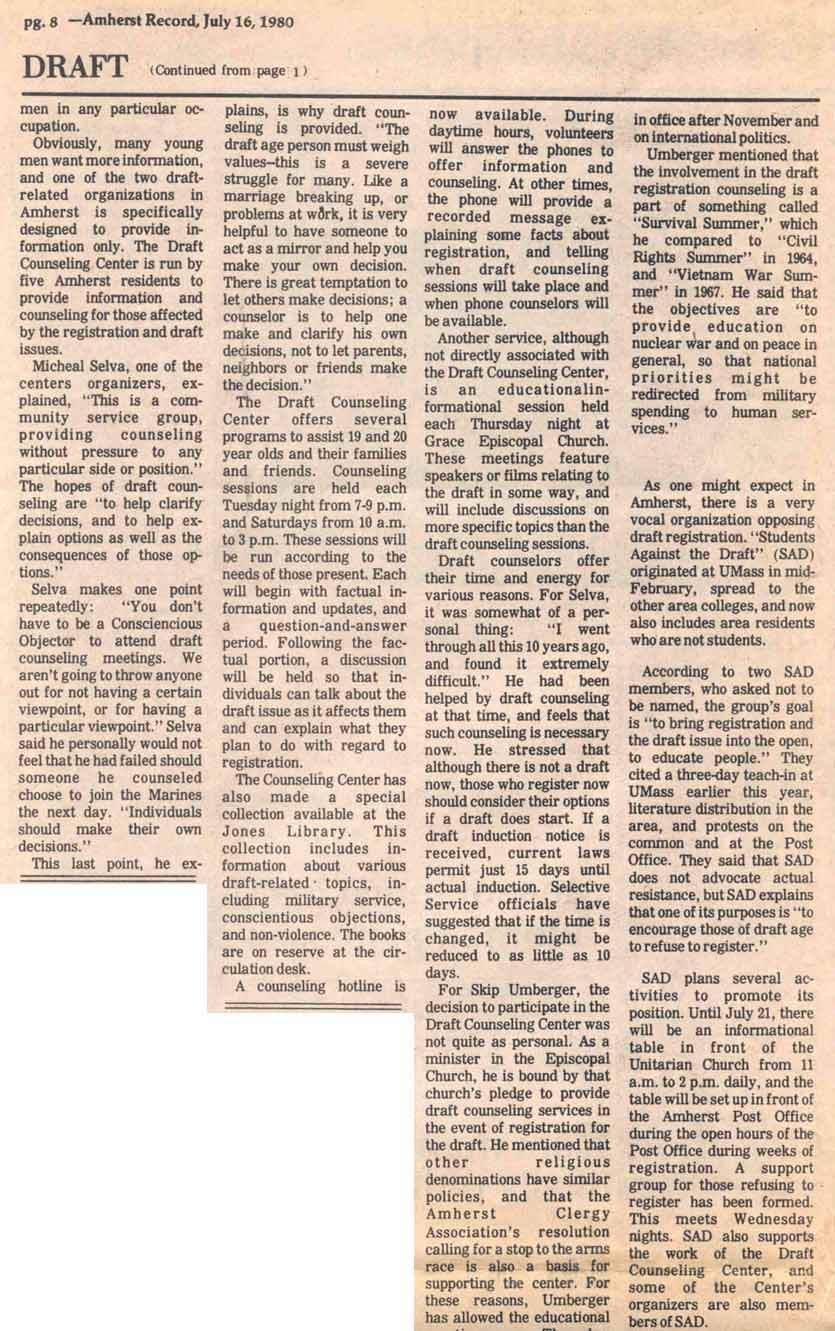
Obviously, many young men want more information, and one of the two draft-related organizations in Amherst is specifically designed to provide information only. The Draft Counseling Center is run by five Amherst residents to provide information and counseling for those affected by the registration and draft issues.
Micheal Selva, one of the centers organizers, explained, “This is a community service group, providing counseling without pressure to any particular side or position.” The hopes of draft counseling are “to help clarify decisions, and to help explain options as well as the consequences of those options.”
Selva makes one point repeatedly: “You don’t have to be a Conscientious Objector to attend draft counseling meetings. We aren’t going to throw anyone out for not having a certain viewpoint, or for having a particular viewpoint.” Selva said he personally would not feel that he had failed should someone he counseled choose to join the Marines the next day. “Individuals should make their own decisions.”
This last point, he explains, is why draft counseling is provided. “The draft age person must weigh values—this is a severe struggle for many. Like a marriage breaking up, or problems at work, it is very helpful to have someone to act as a mirror and help you make your own decision. There is great temptation to let others make decisions; a counselor is to help one make and clarify his own decisions, not to let parents, neighbors or friends make the decision.”
The Draft Counseling Center offers several programs to assist 19 and 20 year olds and their families and friends. Counseling sessions are held each Tuesday night from 7-9 p.m. and Saturdays from 10 a.m. to 3 p.m. These sessions will be run according to the needs of those present. Each will begin with factual information and updates, and a question-and-answer period. Following the factual portion, a discussion will be held so that individuals can talk about the draft issue as it affects them and can explain what they plan to do with regard to registration.
The Counseling Center has also made a special collection available at the Jones Library. This collection includes information about various draft-related topics, including military service, conscientious objections, and non-violence. The books are on reserve at the circulation desk.
A counseling hotline is now available. During daytime hours, volunteers will answer the phones to offer information and counseling. At other times, the phone will provide a recorded message explaining some facts about registration, and telling when draft counseling sessions will take place and when phone counselors will be available.
Another service, although not directly associated with the Draft Counseling Center, is an educational-informational session held each Thursday night at Grace Episcopal Church. These meetings feature speakers or films relating to the draft in some way, and will include discussions on more specific topics than the draft counseling sessions.
Draft counselors offer their time and energy for various reasons. For Selva, it was somewhat of a personal thing: “I went through all this 10 years ago, and found it extremely difficult.” He had been helped by draft counseling at that time, and feels that such counseling is necessary now. He stressed that although there is not a draft now, those who register now should consider their options if a draft does start. If a draft induction notice is received, current laws permit just 15 days until actual induction. Selective Service officials have suggested that if the time is changed, it might be reduced to as little as 10 days.
For Skip Umberger, the decision to participate in the Draft Counseling Center was not quite as personal. As a minister in the Episcopal Church, he is bound by that church’s pledge to provide draft counseling services in the event of registration for the draft. He mentioned that other religious denominations have similar policies, and that the Amherst Clergy Association’s resolution calling for a stop to the arms race is also a basis for supporting the center. For these reasons, Umberger has allowed the educational meetings on Thursday nights to be held in the church facilities, and the Students Against the Draft meetings on Monday nights also.
Umberger’s personal experience also included experience with the military, but he was actually in the Navy when he decided to take up the ministry. He became a Conscientious Objector and went to seminary school.
Both Selva and Umberger feel that the draft will probably be instituted, despite President Carter’s assurances to the contrary. Both also feel that the elections will be over first, and Selva concedes that much depends both on who is in office after November and on international politics.
Umberger mentioned that the involvement in the draft registration counseling is a part of something called “Survival Summer,” which he compared to “Civil Rights Summer” in 1964, and “Vietnam War Summer” in 1967. He said that the objectives are “to provide education on nuclear war and on peace in general, so that national priorities might be redirected from military spending to human services.”
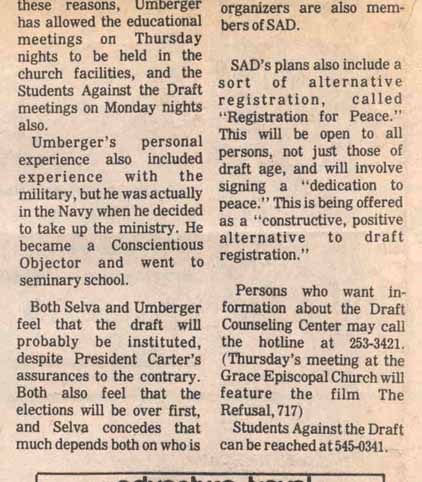
As one might expect in Amherst, there is a very vocal organization opposing draft registration. “Students Against the Draft” (SAD) originated at UMass in mid-February, spread to the other area colleges, and now also includes area residents who are not students.
According to two SAD members, who asked not to be named, the group’s goal is “to bring registration and the draft issue into the open, to educate people.” They cited a three-day teach-in at UMass earlier this year, literature distribution in the area, and protests on the common and at the Post Office. They said that SAD does not advocate actual resistance, but SAD explains that one of its purposes is “to encourage those of draft age to refuse to register.”
SAD plans several activities to promote its position. Until July 21, there will be an informational table in front of the Unitarian Church from 11 a.m. to 2 p.m. daily, and the table will be set up in front of the Amherst Post Office during the open hours of the Post Office during weeks of registration. A support group for those refusing to register has been formed. This meets Wednesday nights. SAD also supports the work of the Draft Counseling Center, and some of the Center’s organizers are also members of SAD.
SAD’s plans also include a sort of alternative registration, called “Registration for Peace.” This will be open to all persons, not just those of draft age, and will involve signing a “dedication to peace.” This is being offered as a “constructive, positive alternative to draft registration.”
Persons who want information about the Draft Counseling Center may call the hotline at 253-xxxx. (Thursday’s meeting at the Grace Episcopal Church will feature the film The Refusal, 717)
Students Against the Draft can be reached at 545-xxxx.
__________________________
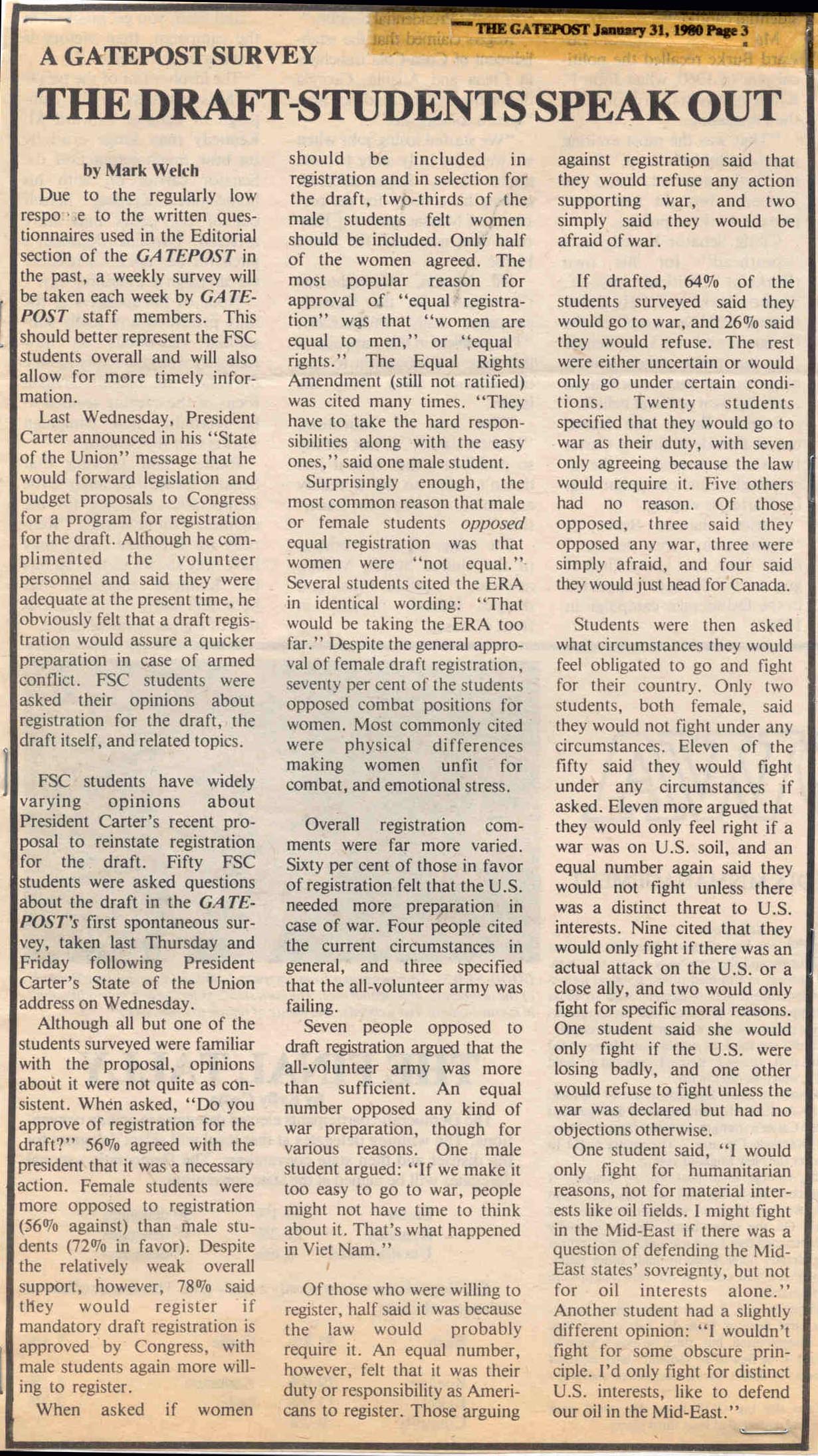
THE GATEPOST January 31, 1980 Page 3
(Framingham State College)
A GATEPOST SURVEY: THE DRAFT-STUDENTS SPEAK OUT
by Mark Welch
Due to the regularly low response to the written questionnaires used in the Editorial section of the GATEPOST in the past, a weekly survey will be taken each week by GATEPOST staff members. This should better represent the FSC students overall and will also allow for more timely information.
Last Wednesday, President Carter announced in his “State of the Union” message that he would forward legislation and budget proposals to Congress for a program for registration for the draft. Although he complimented the volunteer personnel and said they were adequate at the present time, he obviously felt that a draft registration would assure a quicker preparation in case of armed conflict. FSC students were asked their opinions about registration for the draft, the draft itself, and related topics.
FSC students have widely varying opinions about President Carter’s recent proposal to reinstate registration for the draft. Fifty FSC students were asked questions about the draft in the GATEPOST’s first spontaneous survey, taken last Thursday and Friday following President Carter’s State of the Union address on Wednesday.
Although all but one of the students surveyed were familiar with the proposal, opinions about it were not quite as consistent. When asked, “Do you approve of registration for the draft?” 56% agreed with the president that it was a necessary action. Female students were more opposed to registration (56% against) than male students (72% in favor). Despite the relatively weak overall support, however, 78% said they would register if mandatory draft registration is approved by Congress, with male students again more willing to register.
When asked if women should be included in registration and in selection for the draft, two-thirds of the male students felt women should be included. Only half of the women agreed. The most popular reason for approval of “equal registration” was that “women are equal to men,” or “equal rights.” The Equal Rights Amendment (still not ratified) was cited many times. “They have to take the hard responsibilities along with the easy ones,” said one male student.
Surprisingly enough, the most common reason that male or female students opposed equal registration was that women were “not equal.” Several students cited the ERA in identical wording: “That would be taking the ERA too far.” Despite the general approval of female draft registration, seventy per cent of the students opposed combat positions for women. Most commonly cited were physical differences making women unfit for combat, and emotional stress.
Overall registration comments were far more varied. Sixty per cent of those in favor of registration felt that the U.S. needed more preparation in case of war. Four people cited the current circumstances in general, and three specified that the all-volunteer army was failing.
Seven people opposed to draft registration argued that the all-volunteer army was more than sufficient. An equal number opposed any kind of war preparation, though for various reasons. One male student argued: “If we make it too easy to go to war, people might not have time to think about it. That’s what happened in Viet Nam.”
Of those who were willing to register, half said it was because the law would probably require it. An equal number, however, felt that it was their duty or responsibility as Americans to register. Those arguing against registration said that they would refuse any action supporting war, and two simply said they would be afraid of war.
If drafted, 64% of the students surveyed said they would go to war, and 26% said they would refuse. The rest were either uncertain or would only go under certain conditions. Twenty students specified that they would go to war as their duty, with seven only agreeing because the law would require it. Five others had no reason. Of those opposed, three said they opposed any war, three were simply afraid, and four said they would just head for Canada.
Students were then asked what circumstances they would feel obligated to go and fight for their country. Only two students, both female, said they would not fight under any circumstances. Eleven of the fifty said they would fight under any circumstances if asked. Eleven more argued that they would only feel right if a war was on U.S. soil, and an equal number again said they would not fight unless there was a distinct threat to U.S. interests. Nine cited that they would only fight if there was an actual attack on the U.S. or a close ally, and two would only fight for specific moral reasons. One student said she would only fight if the U.S. were losing badly, and one other would refuse to fight unless the war was declared but had no objections otherwise.
One student said, “I would only fight for humanitarian reasons, not for material interests like oil fields. I might fight in the Mid-East if there was a question of defending the Mid-East states’ sovereignty, but not for oil interests alone.” Another student had a slightly different opinion: “I wouldn’t fight for some obscure principle. I’d only fight for distinct U.S. interests, like to defend our oil in the Mid-East.”